
North-Western Germany is composed of the states of Lower Saxony and Schleswig-Holstein,
which in turn contain the city-states of Hamburg and Bremen. The landscape varies
from the plains of northern Germany to the woods of Luneberg Heath in the east and
the rolling hills of the Harz mountains in the south. The main cities are Hamburg,
Hannover, Bremen, Lubeck and Kiel. Its sparse population and good roads make this
an ideal area for a motoring holiday, perhaps centred on the cities in order to
experience the pleasures of these sophisticated centres.
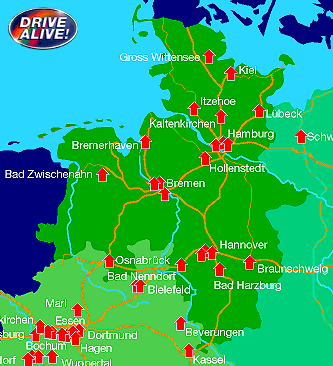
Map of North Western Germany
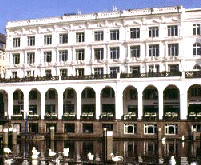
Hamburg is a major city port 120 kms inland on the Elbe. Within the city
are innumerable trees, parks and lakes, giving it an open, green feel. The citiy's
wealth is apparent in the smart houses and appartments, especially around the Alster
lake, and in the smart shops in the Hanseviertel district. Hamburg's nightlife
is world-famous, and the infamous Reeperbahn red light district is only a small
part of this. Add to all this some superb architecture, excellent museums, and a
quality cultural scene to suit every taste, and Hamburg is a city to spend some
time in, armed with a good guide book.
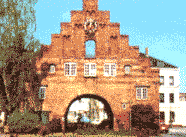
In the far north, bordering Denmark, Germany is a land of marshes and bogs squeezed
between the North Sea and the Baltic. The beaches and islands of the flat North
Sea Coast make a popular holiday destination, especially the island of Sylt
and the working harbour town of Husum, from where ferries cross the 70 kms
of sea to the island of Heligoland. Among the many seaside resorts on the
undulating Baltic coast are smart Travemunde, Laboe with its excellent
beach and Eckernforde, while just inland are the many lakes of Holstein Switzerland.
Visit Lubeck, with its magnificent architecture, its vibrant harbour, its
gastronomic restaurants and lively nightlife. The ancient town of Schleswig,
situated on a beautiful fjord, has some fascinating museums and buildings, especially
the visually superb Dom. Flensburg contains the unique geometric layout of
its Merchants' Courtyards.
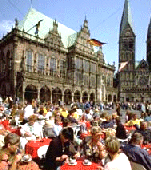
Bremen is situated on the Weser river. Visit the Old Town, with its marketplace
and town hall (Rathaus). Shop on the Sogestrasse and take in the glories of the
Dom church. Stroll through the ancient fishermans' quarter, the Schnoorviertel,
and sample the nightlife in the Ostertorviertel quarter. Try one of the many excellent
fish restaurants, or listen to classical music at the Stadhalle or jazz at the Tivoli,
both close to the Hauptbahnhof (train station). Bremerhaven is the port for
Bremen, and worth a visit for its harbour. If your heading east make sure you stop
in Stade, a port on the Elbe which has undergone a complete restoration of its beautiful
Old Town.
The region between Bremen and the Dutch border is flat and often below sea level.
Along the North Sea coast and on the offshore East Friesan Islands are many popular
holiday resorts with long sandy beaches. Walking and cycling are popular with two
long-distance footpaths, nature reserves and a large and varied bird population.
Visit Oldenburg, with its moated Old Town; Osnabruck, a lively university
town with many interesting sights and buildings; Norden, boasting a large
and lovely marketplace dominated by its bell tower and Ludgerikirche.
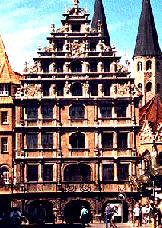
Hannover is a lively city with plenty of night life, good restaurants, and
a lively cultural scene and some excellent museums. Be sure to visit the fine formal
gardens at Herrenshausen. Hameln (Hamelin) is not only worth visiting
for the tale of the Pied Piper, but for its well-restored buildings with their distinctive
gables and overhanging windows. The town of Hindeslheim is considered to
be the prime example of German town architecture and should not be missed. Braunschweig
is another town with many superb buildings, its Old Town surrounded by water. The
rolling countryside of Luneberg Heath is dotted with picturesque timbered
villages. The Naturchutzpark Luneberger Heide in the northwest is best explored
by bike or on foot, along the network of paths. In the south is the Vogelpark Walsrode,
a paradise containing over 5000 birds from all over the world in a beautifully kept
park. Further south is the Naturpark Sudheide, an area of woodland criss-crossed
by marked trails. Nearby are the moving remains of the infamous Concentration Camp
Bergen-Belsen. Visit the towns of Luneberg, formerly famous for salt mining,
with its streets lined by impressive brick buildings, and Celle, a very beautiful
town of half-timbered buildings.
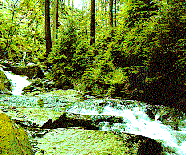
The Harz Mountains are lovely rolling wooded hills offering undemanding but
beautiful walking. Climb the highest peak, the Brocken, by steam railway and enjoy
the easy walk down. Goslar, gateway to the Harz, is a lovely town of half-timbered
buildings, the Kaiserpfalz palace, and many nearby walks. Einbeck also boasts
hundreds of gorgeous half-timbered houses and some imposing public buildings.
Gottingen, with its university, is a lively and cosmopolitan city with plenty
to do and a small but attractive Old Town.
 Drive-Alive on Facebook
© Copyright 1999-2024 Drive-Alive Holidays Ltd - All rights reserved.