
Eastern Austria contains a gorgeous mixture of scenery and places to visit.
The fertile plain of the Danube provides wonderful opportunities for cycling, walking
and nature-watching among timeless villages and lush farmland. Here are the great
cities of Linz and especially Vienna, one of the great cultural and commercial centres
of Europe, rich in history, architecture, and buzzing with life. Away from the river
plain the land rises gently towards the Eastern Alps before they sink in the far
east to the strange and atmospheric wetlands bordering Hungary. In the south and
west is the majestic and relatively undeveloped Alpine scenery of Styria.
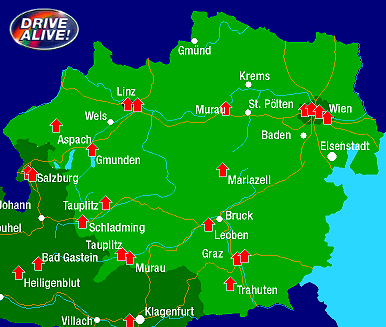
Map of Eastern Austria
Towns and places of interest in east Austria:
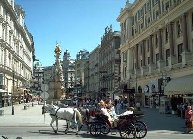
Vienna is one of the great cities of Europe, the crossroads between the
east and west of the continent. You get a real feel of the east here, yet the city
has been home to many of western Europe's greats. Wandering the streets, admiring
the stately buildings, and stopping for the occasional coffee and cake, would keep
you busy for days. Some of Europe's major museums and galleries are in Vienna, and
then there are the walks in the Viennese woods, and maybe a visit to the funfair
with its giant Ferris Wheel, made famous in the film The Third Man. The centre of
the city is compact enough to be explored on foot, or you can use the very efficient
transport system comprising buses, trams and underground (U-Bahn). Make sure you
have a good guide book and get the most out of your visit to this wonderful city.
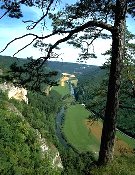
Krems, (nowadays merged with its neighbour Stein and with some interesting
buildings in the old town) and
Melk are the towns at each end of the
Wachau, the name given to this 40 km beautiful and winding stretch of the
Danube.This area is popular locally, with its vine-clad hillsides sloping down to
the river and the many ruined castles dominating the hilltops. The region is excellent
for walking and cycling with well marked trails.
Durnstein is a very pretty town where Richard the Lionheart was imprisoned
until freed by his minstrel Blondel. Melk is overlooked by its spectacular medieval
monastery, well worth a visit as is the old town.
St Polten is the regional capital of Lower Austria. The town contains two
Baroque materpieces, its cathedral's interior and the Institut der Englischen Fraulein.
These are offset by the modern architecture of the town's new centre, especially
the spectacular and quirky Shedhalle. Towns worth visiting around St Polten include
Pottenbrunn with its castle, the monastery at
Herzogenburg, or the pretty village of
Lilienfeld set in the wooded foothills of the Alps and offering good and
easy walking.
Lackenhof and
Waidhofen are two of the resort towns in the Alpine area of
Ybbstal, and from both there is excellent walking in summer or skiing in
winter.
 In
the southeast corner of Austria is the
Burgenland. Here is the Neusiedler See, Austria's largest lake and
popular holiday destination, with swimming and watersports. The flat reedy countryside
is ideal for cycling and touring the pretty wine-growing villages nearby. In
Eisenstadt tour the Estherhazy castle where Joseph Haydn spent most
of his life.
In
the southeast corner of Austria is the
Burgenland. Here is the Neusiedler See, Austria's largest lake and
popular holiday destination, with swimming and watersports. The flat reedy countryside
is ideal for cycling and touring the pretty wine-growing villages nearby. In
Eisenstadt tour the Estherhazy castle where Joseph Haydn spent most
of his life.
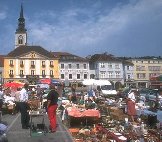 Graz
in Styria is Austria's second city and an excellent base for exploring the
region. Plenty to see, (castles, museums), walks along the river Mur, strolls in
the old town, and a lively nightlife.Nearby attractions are Schloss Eggenburg and
the open-air museum of Austrian village architecture at
Stubing. Drive through the rolling hills of the wine-growing area south of Graz
or head 50 kms east to
Feldbach and visit the spectacular fortress of Schloss Riegersburg
Graz
in Styria is Austria's second city and an excellent base for exploring the
region. Plenty to see, (castles, museums), walks along the river Mur, strolls in
the old town, and a lively nightlife.Nearby attractions are Schloss Eggenburg and
the open-air museum of Austrian village architecture at
Stubing. Drive through the rolling hills of the wine-growing area south of Graz
or head 50 kms east to
Feldbach and visit the spectacular fortress of Schloss Riegersburg
 Western
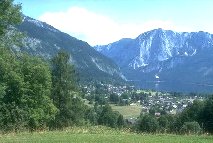
Styria has some of the most beautiful Alpine scenery anywhere, but is much less
developed than the Tyrol. Becoming progressively higher and wilder as you move west
from Graz, the area is wonderful for summer walking, and
Schladming is the main winter sports resort.
Western
Styria has some of the most beautiful Alpine scenery anywhere, but is much less
developed than the Tyrol. Becoming progressively higher and wilder as you move west
from Graz, the area is wonderful for summer walking, and
Schladming is the main winter sports resort.
The
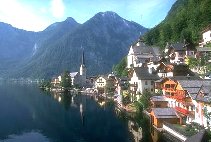
Salzkammergut is Austria's lake district, easily reached from
Salzburg or southern Germany. Beautiful still lakes surrounded by mighty peaks
provide beaches, swimming and watersports of all sorts, excellent walking with easy
access to the high meadows and good skiing patronised more by locals than tourists.
Pretty towns and villages abound. The four main lakes are the Hallstattersee,
perhaps the most beautiful with the lovely town of
Hallstatt and its Celtic museum, the extremely attractive
Wolfgangsee with good easy skiing, the
Mondsee for sailing and windsurfing, and the
Traunsee, perfect for families, with its bustling resort of
Gmunden. The main town of the area is
Bad Ischl, an attractive and lively spa town.
 Drive-Alive on Facebook
© Copyright 1999-2024 Drive-Alive Holidays Ltd - All rights reserved.