
Northern Spain is rightly known as Green Spain. Its climate is influenced by its proximity to the Atlantic Ocean, and rain is as common as it is in western Britain. The advantage is the lush and verdant landscape, with gems such as the Picos de Europa mountains and the beautiful Northern coastline of sandy coves and hidden harbours. Add to this towns like San Sebastian and Santander, Bilbao with the Guggenheim Museum, and Santiago de Compostella in the west, and it's easy to see why Northern Spain is increasing in popularity as a holiday destination. Nestling between France and Spain amidst the high Pyrenees is the tax haven and ski area which is Andorra.
Towns and places of interest in Northern Spain:The provinces of Asturias and Cantabria are blessed with some of
Spain's most spectacular scenery. Mountains abound, and superb walking trails
are everywhere. The countryside is green and verdant, and the coastline is one of
high cliffs interspersed with numerous rocky coves and golden sandy beaches. The
resorts of Llanes and Ribadesella are good centres for exploring the
coast. The extraordinarily beautiful mountains of the Picos de Europa straddle
the borders between the two provinces and offer spectacular but generally easy walking.
Stay in the still relatively unspoilt town of Potes, or the somewhat more
modern Cangas de Onis. Cider is the drink in Cantabria, but be prepared for
the waiter to pour a small quantity from a bottle held at shoulder height, which
you should down in one and wait for your glass to be re-filled.
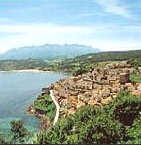
Burgos, with its spectacular cathedral, is one of many beautiful inland cities
of northern Spain. Also well worth visiting are big and lively Zaragoza in
the historic province of Aragon, while Salamancar and Leon
in Castille-Leon boast wonderful monuments and towering Gothic cathedrals. However,
perhaps the biggest draw to inland northern Spain is the great mountain range of
the Pyrenees. Here is every sort of activity associated with mountains; excellent
walking on well-marked trails, climbing, mountain biking, and winter sports; all
among some of the most beautiful scenery in Europe.
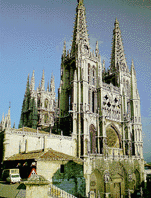
If you come from Wales or Cornwall you'll feel at home in Galicia, Spain's
western extremity. The countryside, coastline and people all bear a resemblance
to their Celtic counter-parts in the UK, except for the strong Catholic tradition,
which it shares with Ireland. The scenery is wild and spectacular, and the weather
unpredictable. The beaches are few and far between, but gorgeous, the coast being
deeply cut by fjord-like rias, and here the lush and wooded countryside is a delight.
Inland, the granite landscape is bleak and unforgiving.
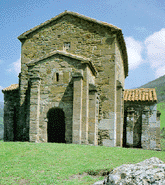
San Sebastian is most important town of the Basque region, and its Basque
name is Donostia. It's a delightful seaside resort as well as an important
commercial centre. The more modern part of the town has wide, open boulevards, while
the old town is a warren of narrow streets crowded around the harbour with its distinctive
painted houses and excellent fish restaurants. The town is dominated by the high
peninsular of Mount Urgull with its imposing statue of Christ, a favourite
place for walking. The town has several excellent beaches and a lively nightlife,
with bars catering for all tastes.
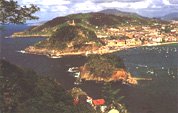
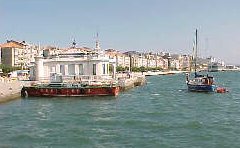
In the east is the elegant resort city of Santander, ferryport for boats
from Plymouth. The town has a sophisticated air, and the lovely promenade along
its excellent main beach is filled with strollers on fine days. The rocky coast
around is worth exploring either by walking to the west or by car to the east. The
city spreads inland behind the beach and has a lively centre with many good restaurants
and bars, although lacking a little in cultural interest. About 30 kms west lies
the superbly preserved medieval village of Santillana del Mar.
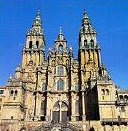
Santiago de Compostella is the third holiest place in the Christendom, after
Jerusalem and Rome. As the supposed shrine of Saint James the Apostle it has been
a place of pilgrimage for centuries. The town is a compact and beautifully preserved
example of a medieval walled town, and the golden granite from which it was built
lends it a warm glow. The cathedral is one of the most stunning in western Europe.
Being in the far west of Spain, rain is frequent, and the mossy vegetation which
covers many buildings serves to enhance the visual effect. As Santiago is a thriving
university town it also has a reasonably lively nightlife and some good bars and
restaurants.
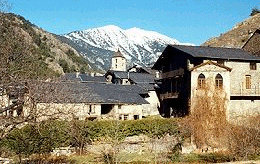
Andorra is a landlocked principality in the heart of the Pyrenees, bordering
both France and Spain. The terrain is mountainous, with three deep valleys, and
although rather bleak, offers some of the best skiing in Europe. The capital is
Andorra la Vella. The average altitude of the Principality is 1996 m. It has the
largest skiable area in the Pyrenees. For more information on the different resorts,
click here.
The special tax regime results in
low cost shopping,
and the summer sun makes for a pleasant walking holiday among the mountains. The
Principality of Andorra can be accessed by road from France through Pas de la Casa
and the Envalira Pass and from Spain via Sant Julia de Loria.The nearest main cities
are Barcelona (185 km) and Lleida (151 km) on the Spanish side, and Toulouse (187
km) and Perpignan (169 km) on the French side.
 Drive-Alive on Facebook
© Copyright 1999-2024 Drive-Alive Holidays Ltd - All rights reserved.